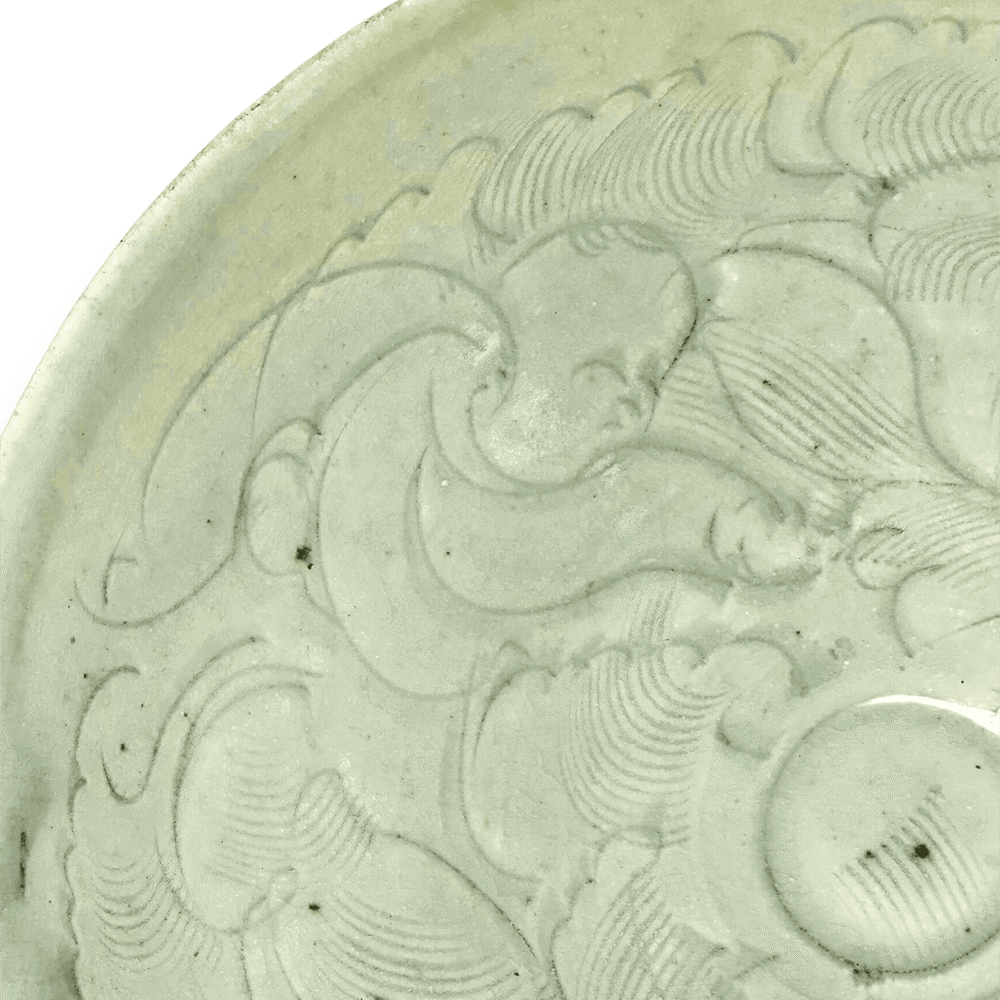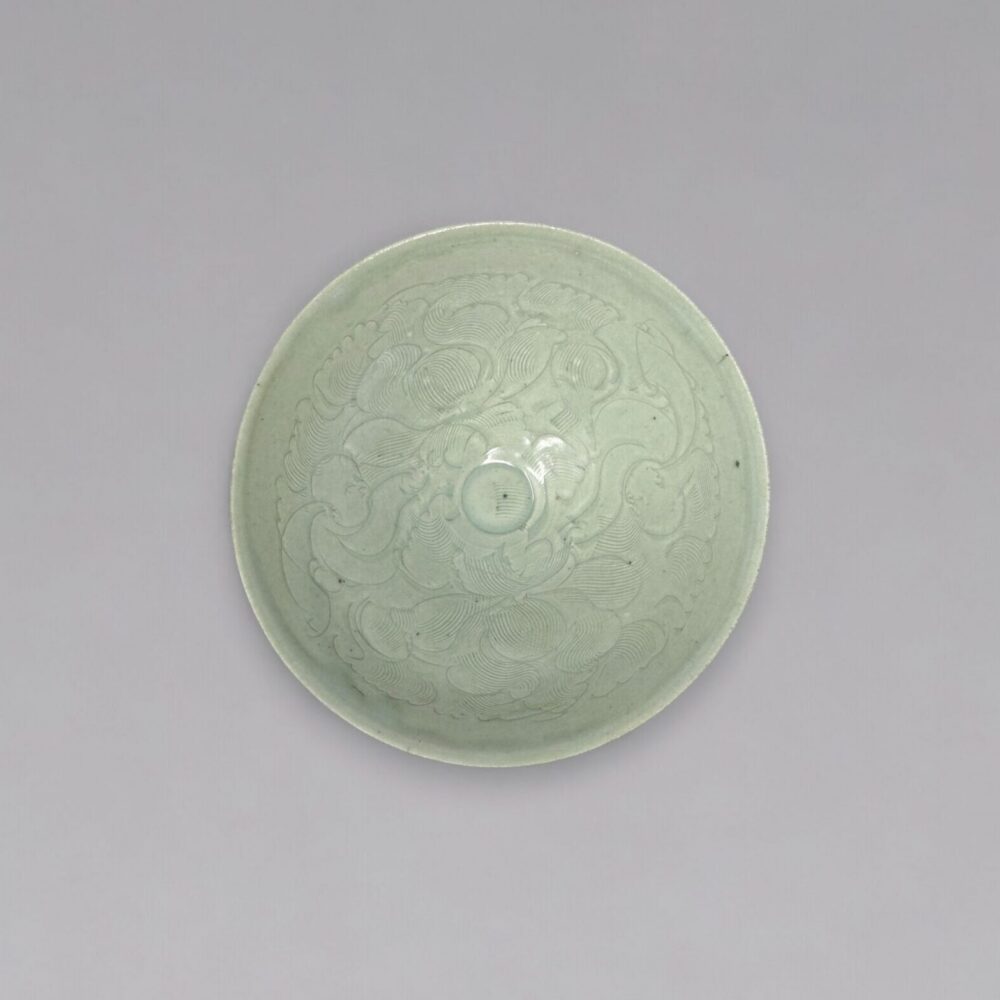
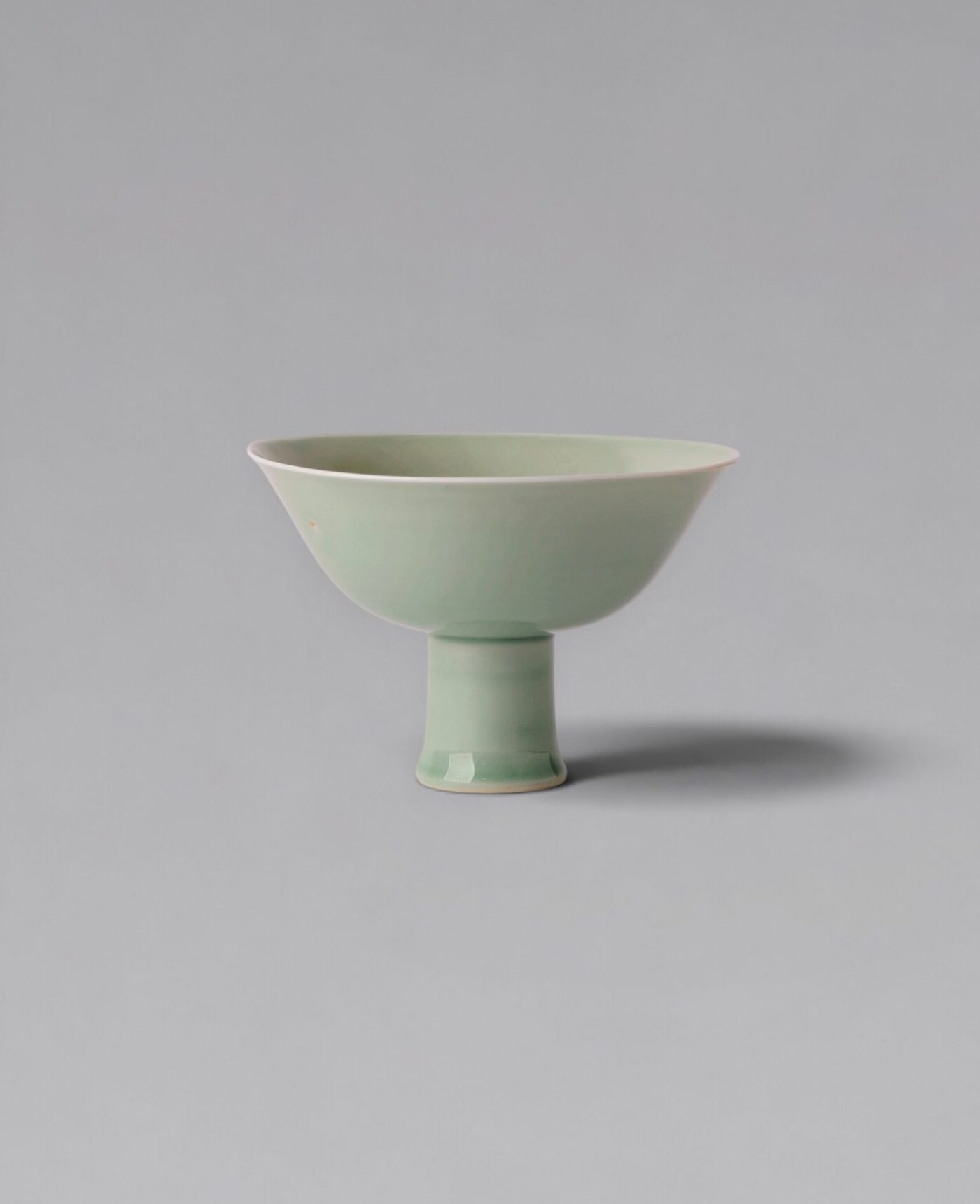
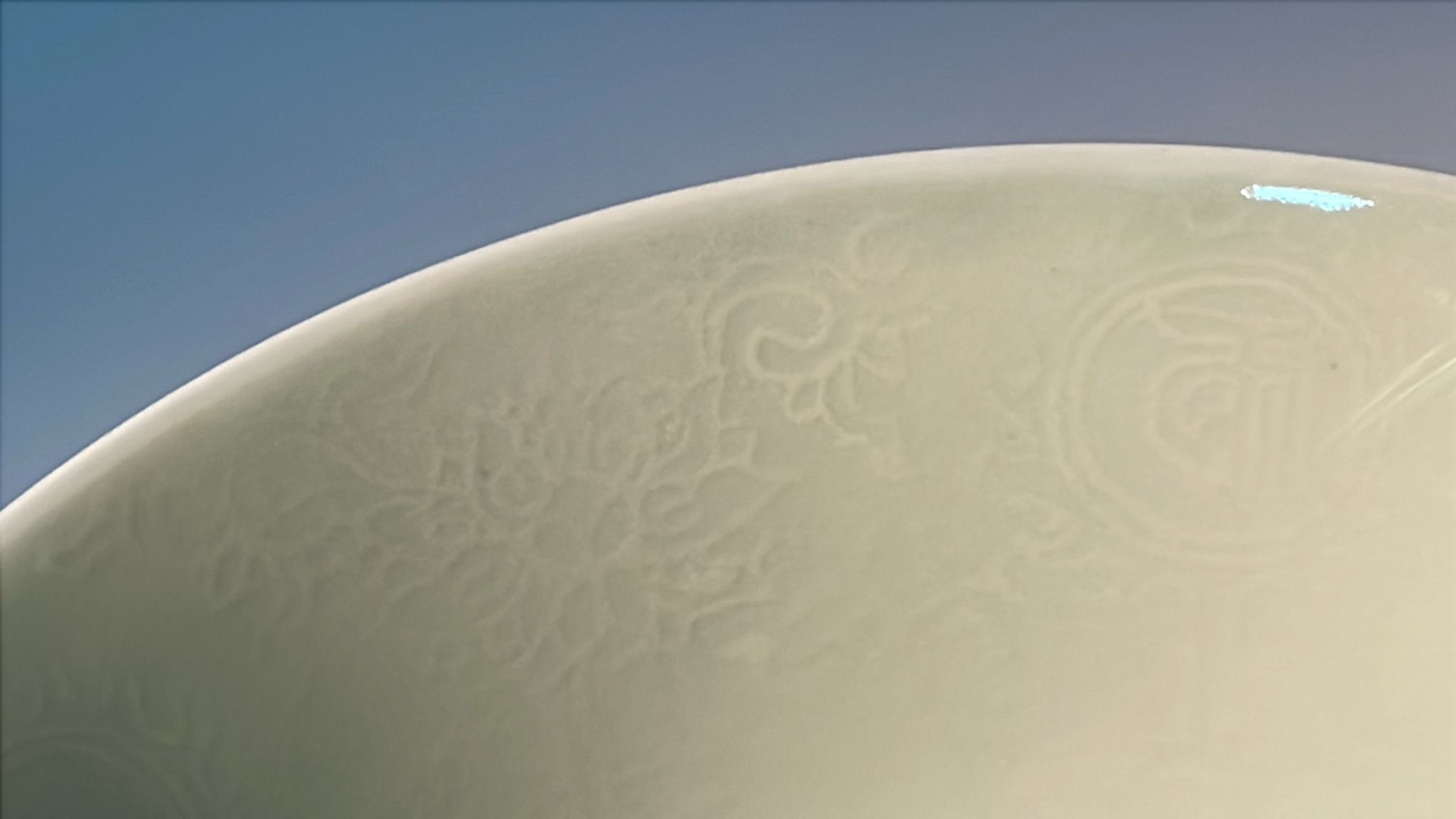
The cup finely potted with a domed bowl rising from a tall, slightly flared foot, the proportions elegant and well balanced. The interior is delicately decorated in anhua (hidden decoration) technique with four Tibetan Lantsa characters enclosed within a flaming medallion, issuing from cloud scrolls and surrounded by lotus motifs. The exterior is left plain, covered overall in ‘wintergreen’ dongqing glaze of pale green hue, thinning towards the rim and pooling subtly in the recesses of the decoration.
A rare wintergreen Anhua-decorated stem cup
Description
Qing dynasty, Qianlong period (1736-1795)
Dimensions: 10 cm high, 14.5 cm diameter
Provenance:
Collection Annelotte Elbrecht (1924-2013)
A private Dutch collection
The cup finely potted with a domed bowl rising from a tall, slightly flared foot, the proportions elegant and well balanced. The interior is delicately decorated in anhua (hidden decoration) technique with four Tibetan Lantsa characters enclosed within a flaming medallion, issuing from cloud scrolls and surrounded by lotus motifs. The exterior is left plain, covered overall in ‘wintergreen’ dongqing glaze of pale green hue, thinning towards the rim and pooling subtly in the recesses of the decoration.
Wares of this type, while inspired by the rare and highly refined porcelains of the early Yongle period, are here reinterpreted in the Qianlong period, reflecting the later court’s sustained interest in archaism. The use of anhua decoration, delicately incised beneath a monochrome glaze, echoes the restrained aesthetic associated with the Yongle court. The motifs used, such as Tibetan Lantsa script and Buddhist imagery, recall the strong influence of Tibetan Buddhism at the early Ming court, consciously revived under the Qianlong Emperor.
The glaze on this stem cup is of particularly fine quality, with a soft, luminous surface enhancing the subtlety of the incised design. The tone, often described as ‘wintergreen’, differs from more typical celadon glazes in its clarity and understated character. It is rooted in effects first achieved at Jingdezhen during the Yongle reign, drawing inspiration from the sea-green wares of the Longquan kilns. Examples of this colour and technique remain notably rare.
Stem cups of this type appear to have been produced in limited numbers, likely for ritual or court use and their survival is uncommon. Comparable examples from the Yongle period are preserved in the Tibet Museum, illustrated in Ming and Qing Dynasties Ceramics Preserved in Tibet Museum, Beijing 2004, pl. 26 and another example with slight damage in the Palace Museum Beijing, illustrated in Geng Baochang, ed., Selection of ancient ceramic material from the Palace Museum, Beijing 2005 Vol 1 Plate 88. Another was sold at Sotheby’s London, 19 November 1986, lot 215, and again 8 October 2013, lot 3028.