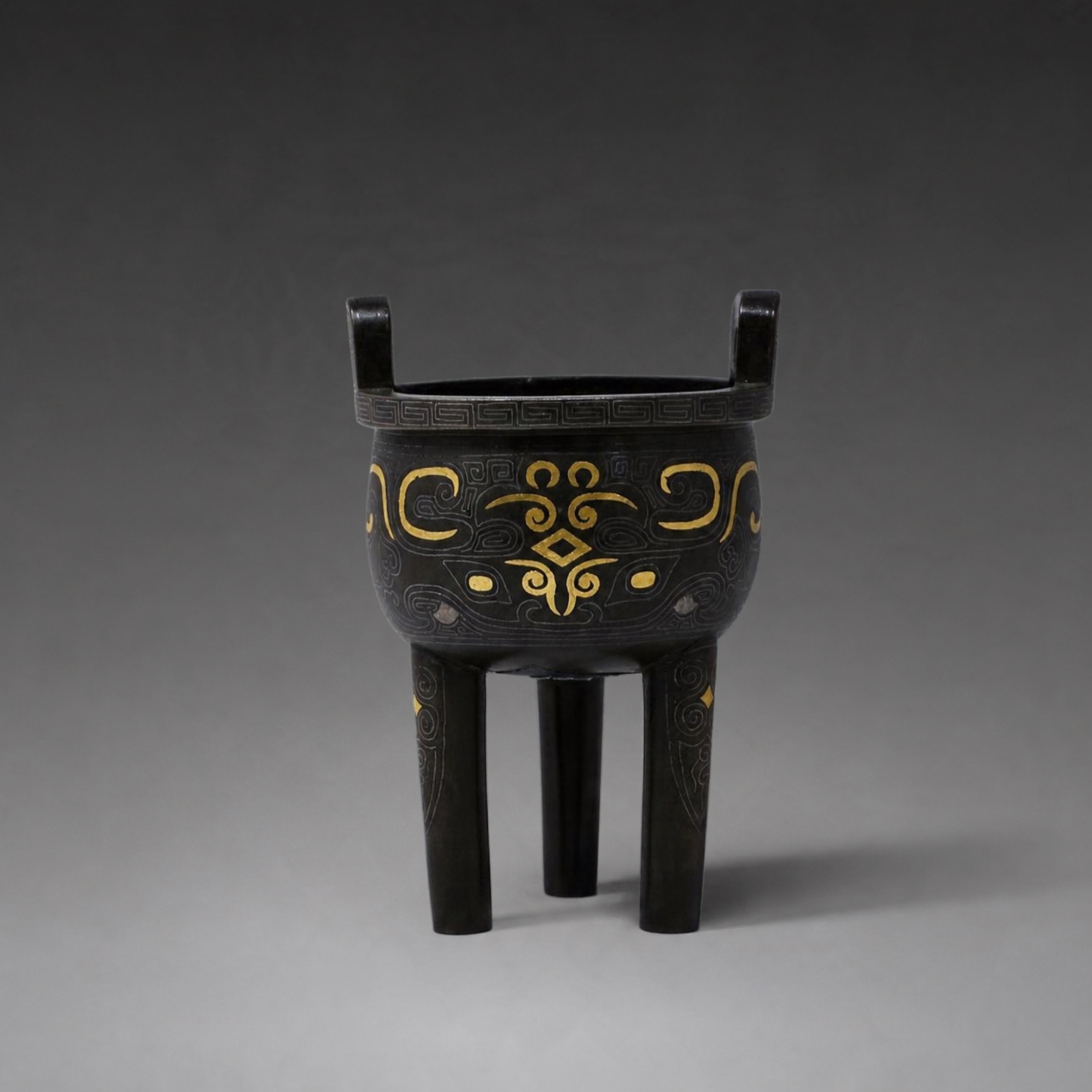
The bronze censer has a deep, u-shaped body supported on three tubular legs, with two upright loop handles rising from the rim. The body is inlaid in gold and silver with two taotie masks beneath a key-fret border. Stylised cicada lappets decorate the legs.
A small gold- and silver-inlaid bronze ‘ding’ censer (Qing dynasty, 18th century)
Description
Dimensions:
9.5 cm high; weight: 265 g.
Provenance:
Maria Kiang Chinese Art, Hong Kong
A private Asian collection
The bronze censer has a deep, u-shaped body supported on three tubular legs, with two upright loop handles rising from the rim. The body is inlaid in gold and silver with two taotie masks beneath a key-fret border. Stylised cicada lappets decorate the legs.
Small censers of this type, known as qinlu, were used to burn a single stick of incense during music appreciation. The present example follows the form of an archaic bronze ding, with gold and silver inlay defining the masks and geometric borders.
Additional information
| Period | Qing dynasty, 18th century |
|---|---|
| Dimensions | 9.5 cm high; weight: 265 g |