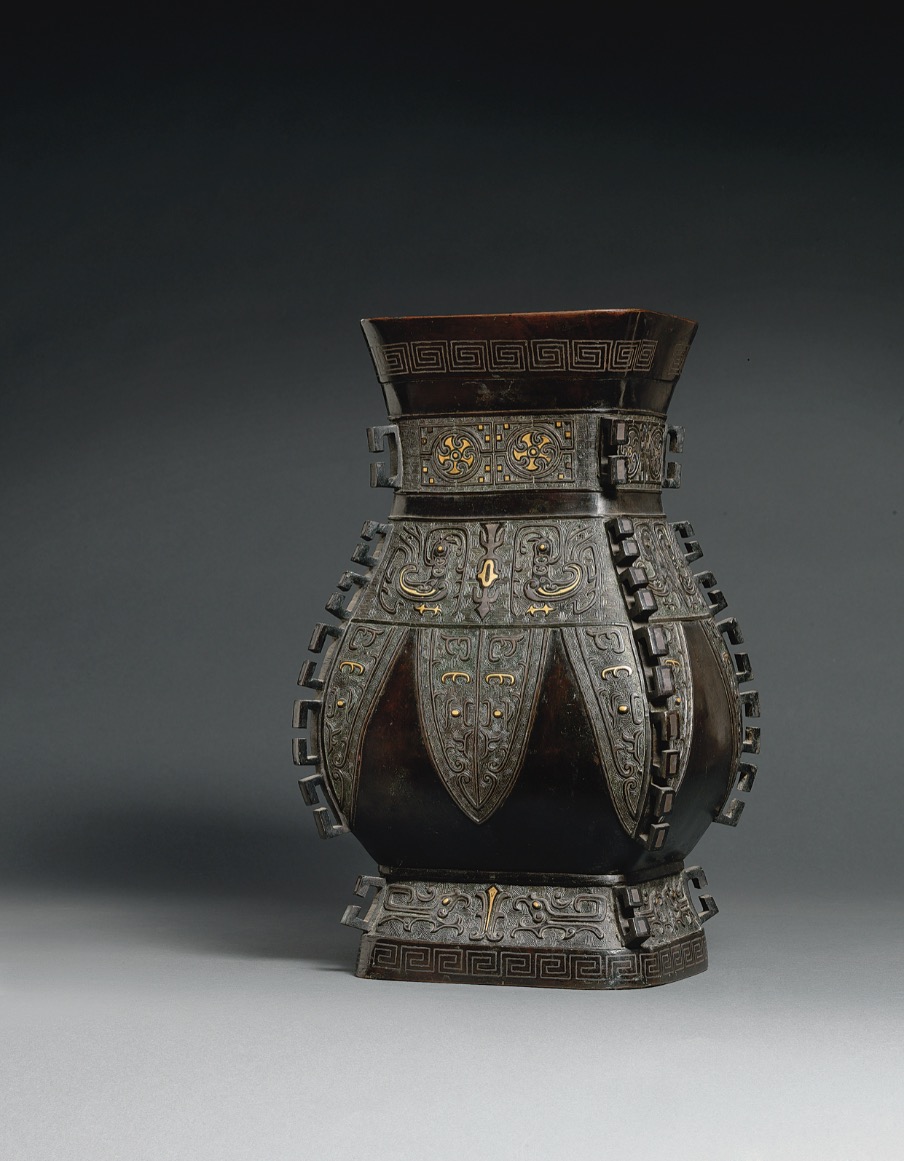
The bronze vessel is of rectangular form, with a gently pear-shaped body and hooked flanges at the corners. A band of pendent blades encircles the neck, above stylised phoenix and cicada-leaf motifs on the body. Confronting dragons decorate the foot. The cast body is enriched with gold and silver inlay against a deep brown patina.
An archaistic gold- and silver-inlaid bronze ‘fanghu’ (Qing dynasty, 18th century)
Description
Dimensions:
46.9 cm high
Provenance:
Christie’s London, 6 November 2007, lot 111
Littleton & Hennessy Asian Art
Published:
Littleton & Hennessy Asian Art, Later Chinese Bronzes, Asian Art in London 2020, no. 16
The bronze vessel is of rectangular form, with a gently pear-shaped body and hooked flanges at the corners. A band of pendent blades encircles the neck, above stylised phoenix and cicada-leaf motifs on the body. Confronting dragons decorate the foot. The cast body is enriched with gold and silver inlay against a deep brown patina.
The form and decoration follow archaic bronze prototypes, combining corner flanges, animal motifs and geometric borders in a Qing interpretation of the ritual fanghu, with precious-metal inlay emphasising the relief decoration. Cicadas suggest renewal and transformation, while stylised phoenix motifs carry later associations of virtue, harmony and auspicious rule, although their meaning on early bronzes remains uncertain. Together, these motifs evoke the ritual prestige of antiquity.
Additional information
| Period | Qing dynasty, 18th century |
|---|---|
| Dimensions | 46.9 cm high |