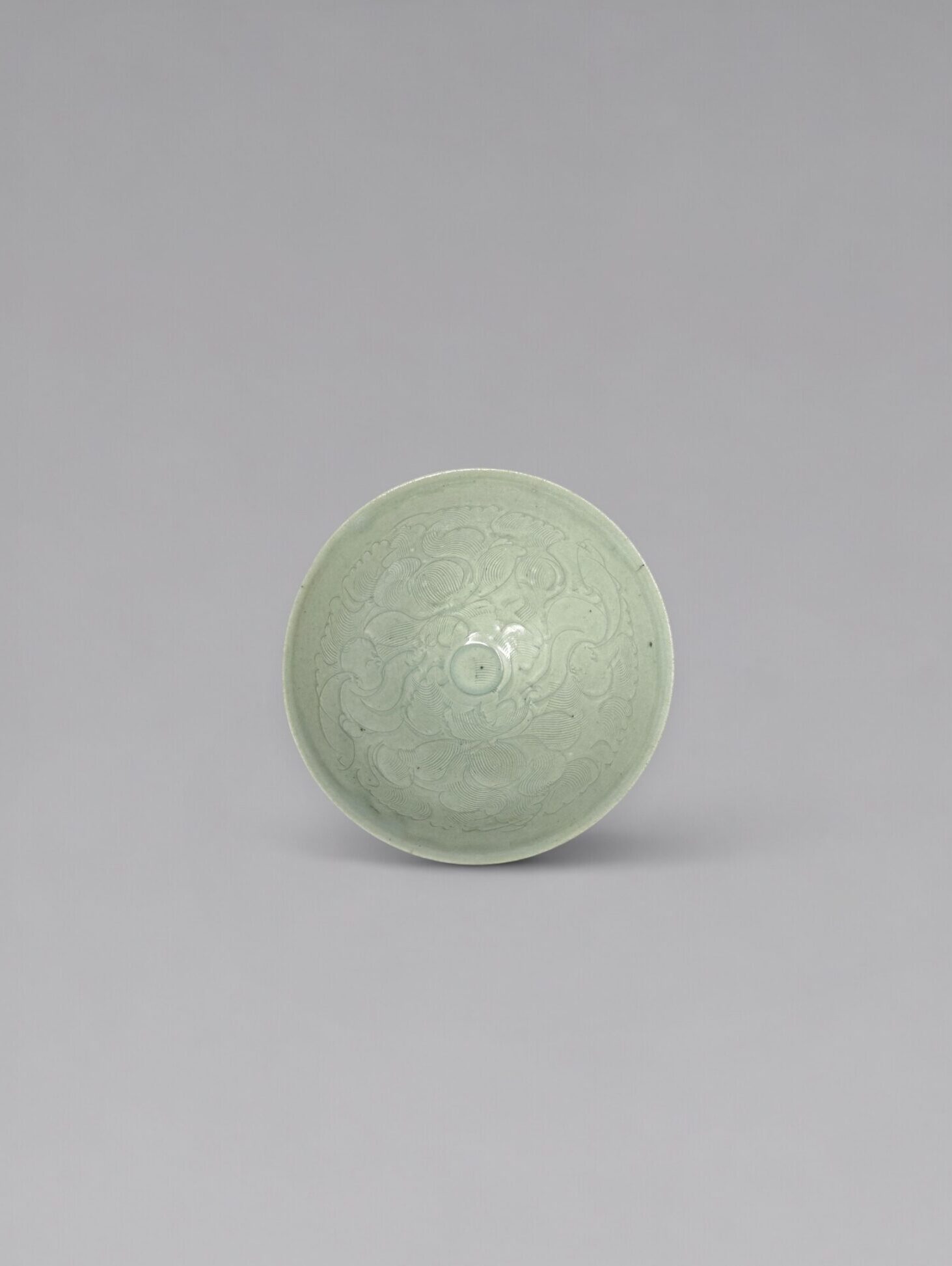
Delicately potted with thin, translucent walls rising from a short foot to an everted rim, the interior crisply moulded with a joyous scene of boys at play amid scrolling lotus and peony sprays, the exterior plain. Covered overall with a lustrous, pale bluish glaze pooling to a deeper tone in the recesses and thinning at the rim to reveal the fine white body beneath.
A Qingbai ‘boys’ bowl
Description
Song dynasty (960-1279)
Dimensions: 19.6 cm diameter, 7 cm high
Provenance:
A private Scandinavian collection, acquired in the 1980s and 1990s
Delicately potted with thin, translucent walls rising from a short foot to an everted rim, the interior crisply moulded with a joyous scene of boys at play amid scrolling lotus and peony sprays, the exterior plain. Covered overall with a lustrous, pale bluish glaze pooling to a deeper tone in the recesses and thinning at the rim to reveal the fine white body beneath.
Jan Wirgin, in ‘Sung Ceramic Design’, London, 1979, p. 179–181, suggests that the lively motif of boys amidst scrolling lotus derives, in part, from early Indian cave imagery and Tang Buddhist depictions of souls reborn upon lotus blossoms. By the Song dynasty, this theme had evolved into one of the most cherished symbols of prosperity and fecundity. Its joyful composition appears across a wide range of materials, silver, bronze, textile, jade and at leading ceramic centres including Yaozhou, Ding, and Jingdezhen, where it found exquisite expression in the translucent Qingbai wares. The present bowl exemplifies this refined tradition, its crisp relief and luminous glaze capturing the serene elegance of Southern Song craftsmanship.