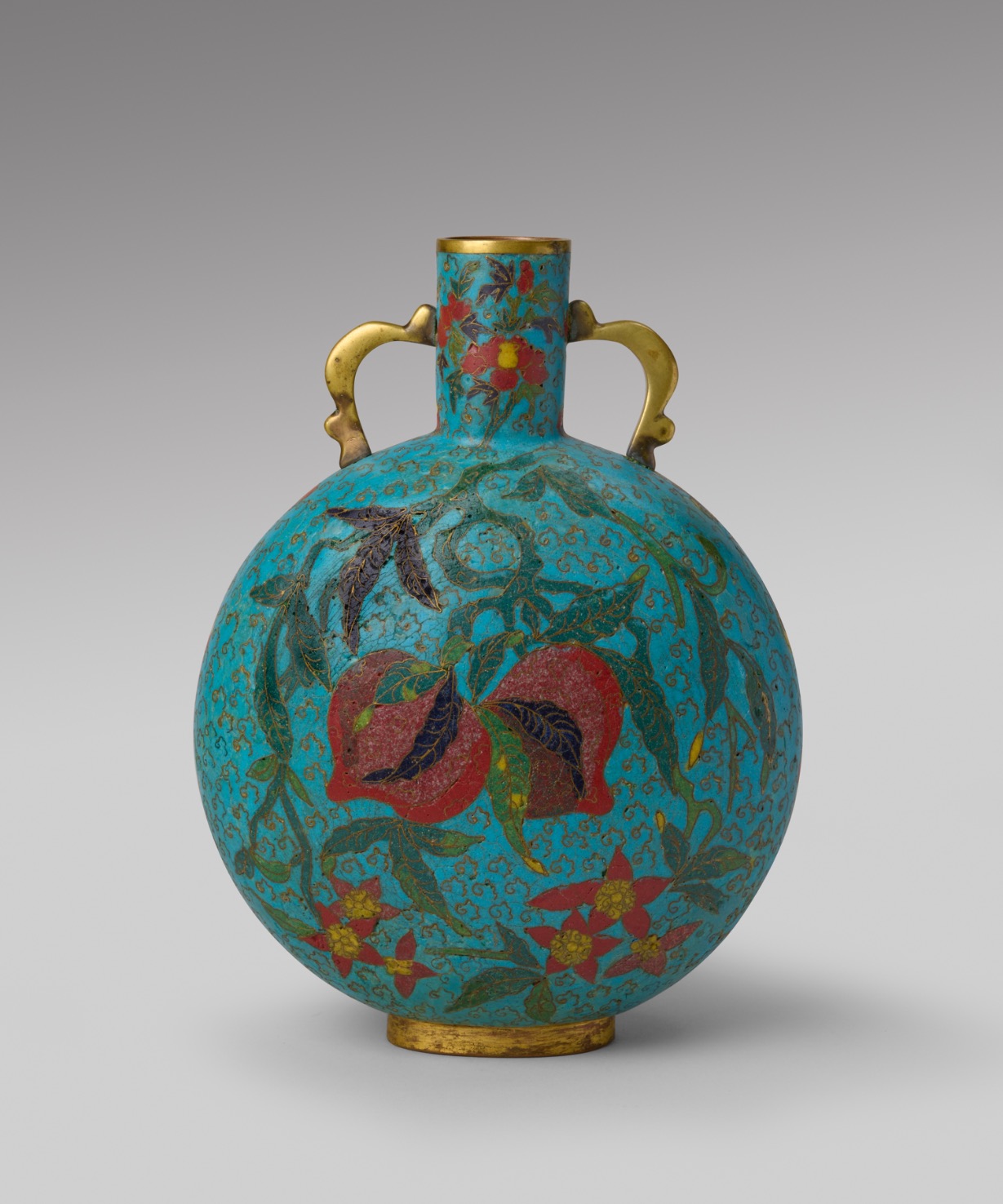
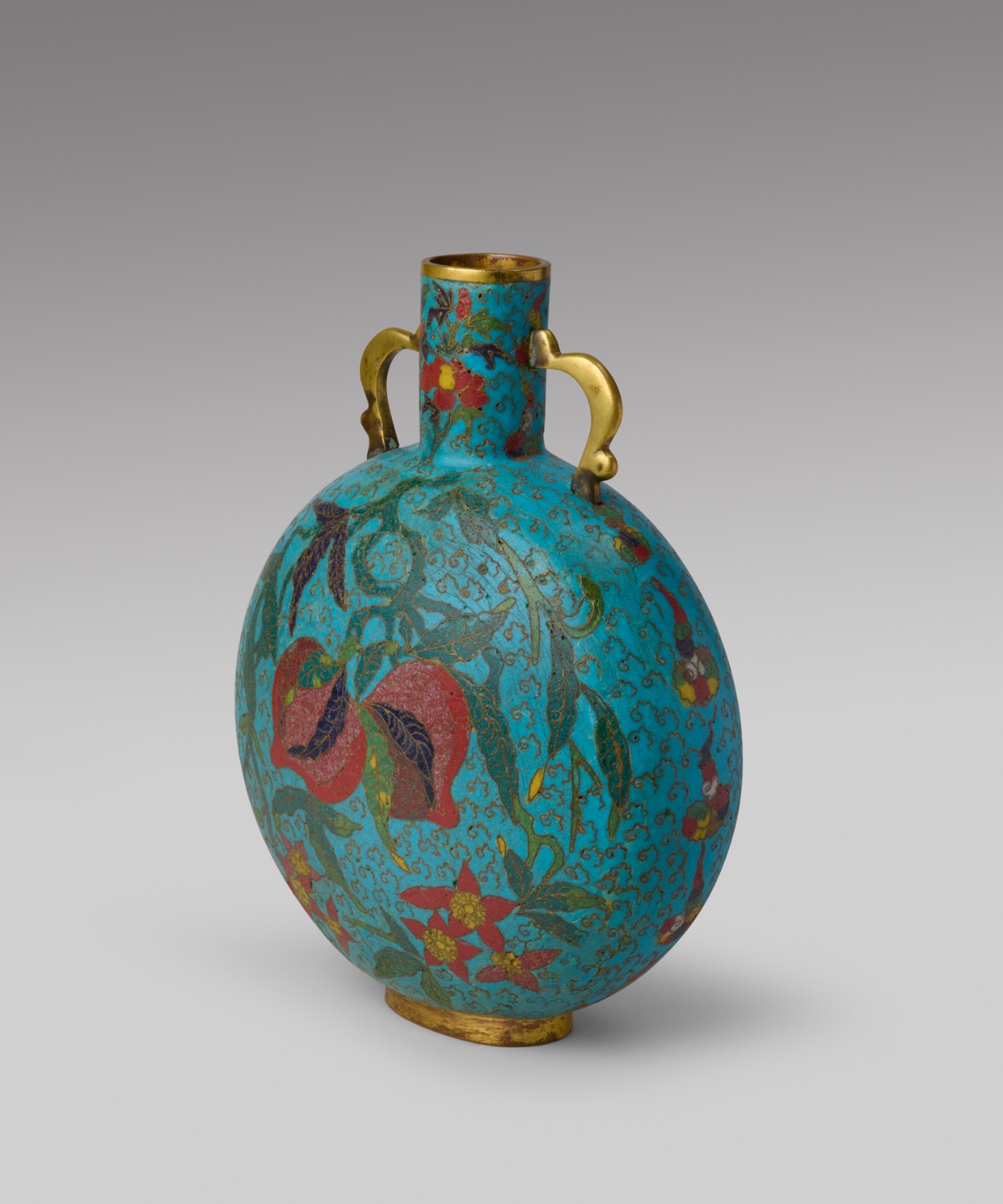
The cloisonné enamel flask has a flattened, rounded body supported on an oval foot ring, rising to a short cylindrical neck flanked by two loop handles. The two broad faces are decorated with flowering and fruiting branches, bearing peaches on one side and pomegranates on the other.
A cloisonné enamel ‘peaches and pomegranate’ moonflask ‘baoyueping’ (Ming dynasty, first half of the 17th century)
Description
Dimensions:
25 cm high
Provenance:
A private Belgian collection
Galery Lamy – Oriental Fine Arts, Brussels
Littleton & Hennessy Asian Art, London
The cloisonné enamel flask has a flattened, rounded body supported on an oval foot ring, rising to a short cylindrical neck flanked by two loop handles. The two broad faces are decorated with flowering and fruiting branches, bearing peaches on one side and pomegranates on the other.
The form derives from early Ming porcelain prototypes, including two 15th-century examples in the National Palace Museum, Taipei, illustrated in Blue-and-White Ware of the Ming Dynasty, Book II, Part 1, Hong Kong, 1963, pp. 38–41, pls. 9–10c. Compare two closely related cloisonné flasks decorated with leafy peach branches, dated to the first half of the 17th century, illustrated by H. Brinker and A. Lutz in Chinesisches Cloisonné: Die Sammlung Pierre Uldry, Zurich, 1984, pls. 136 and 138. The latter is recorded as being of the same size as the current example, with an inverted gilt-bronze rim.
Further related examples, bearing Jingtai mark and likewise dated to the first half of the 17th century, can be found in the National Palace Museum, Taipei, illustrated in Enamel Ware in the Ming and Ch’ing Dynasty, Taipei, 1999, no. 16 and in the Brooklyn Museum, illustrated by Getz, 1912, pl. 47.
Additional information
| Period | Ming dynasty, first half of the 17th century |
|---|---|
| Dimensions | 25 cm high |