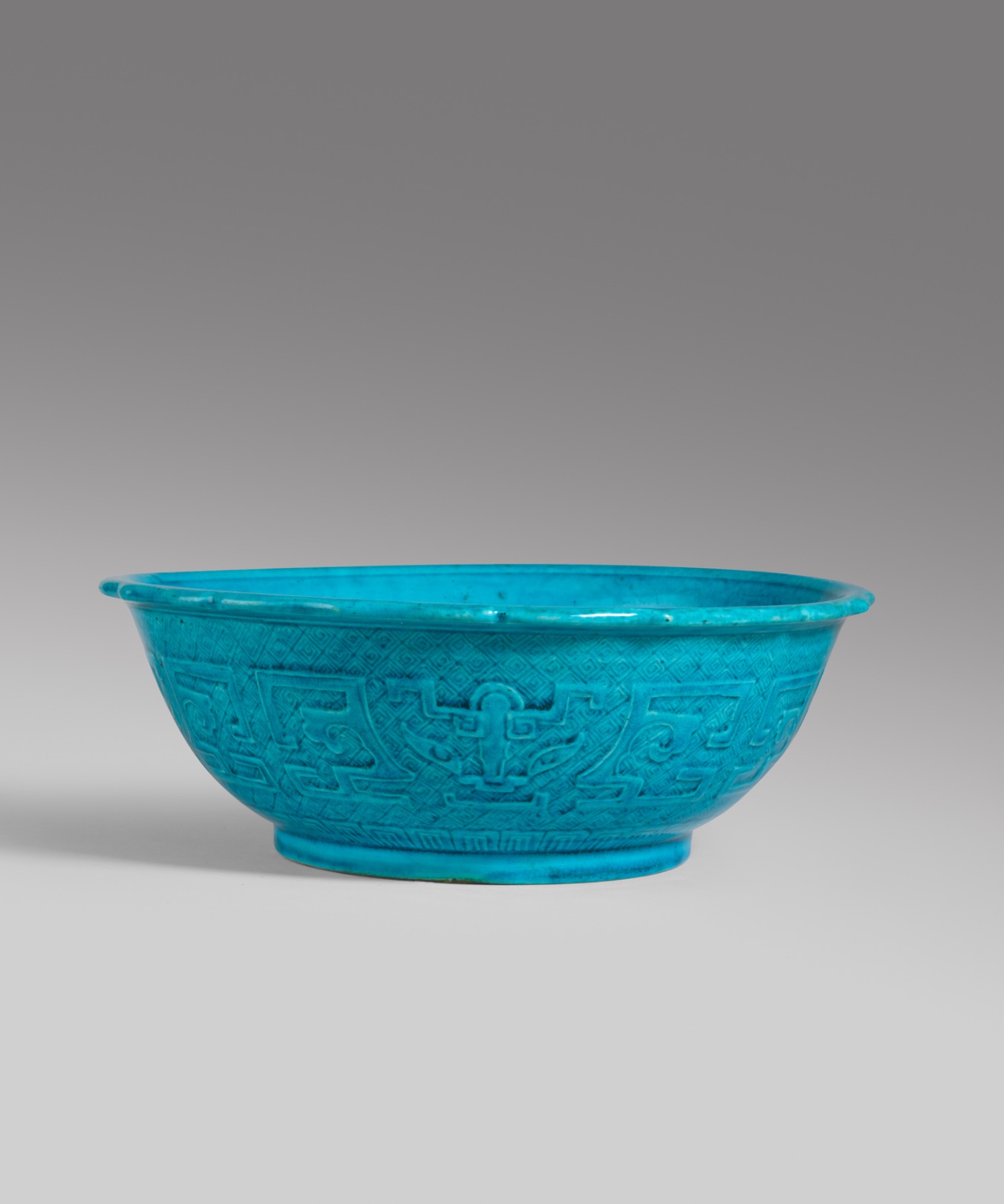
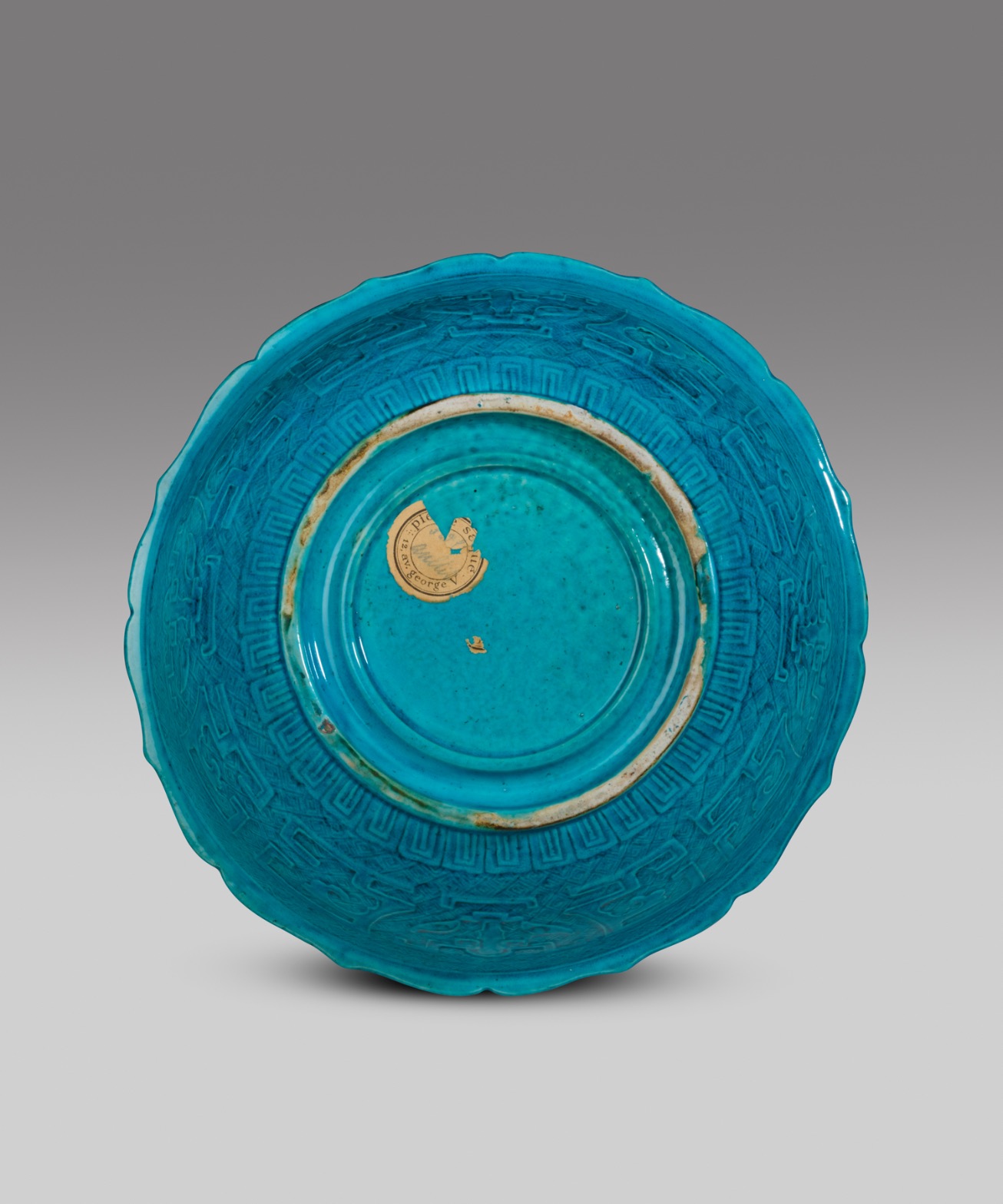
The bowl has deep, rounded sides rising to a flaring, barbed rim and is supported on a short, channelled foot ring. The exterior is carved and moulded with bands of archaistic taotie masks on a diamond-diaper ground, above pendent lappets. The bowl is covered overall in a turquoise glaze, including the foot ring and base.
A large turquoise-glazed bowl (Qing dynasty, Kangxi period, 1662–1722)
Description
Dimensions:
27 cm diameter
Provenance:
Pierre Saqué, Paris, a Chinese antiquities dealer active during the first half of the 19th century, operating from 12 avenue George V
Littleton & Hennessy Asian Art, London
Published:
Littleton & Hennessy Asian Art, Exhibition of Chinese Ceramics, Asia Week New York, 2004, no. 11, pp. 26–27
The bowl has deep, rounded sides rising to a flaring, barbed rim and is supported on a short, channelled foot ring. The exterior is carved and moulded with bands of archaistic taotie masks on a diamond-diaper ground, above pendent lappets. The bowl is covered overall in a turquoise glaze, including the foot ring and base.
Turquoise glaze was used during the Kangxi period both as a monochrome covering and alongside other colours on biscuit-fired porcelain. Coloured with copper and fired at a relatively low temperature, it produced a vivid blue-green surface, sometimes finely crackled. Its rich colour was particularly effective on moulded vessels and figures, accentuating their contours and relief decoration, as in the present example.
Additional information
| Period | Qing dynasty, Kangxi period (1662–1722) |
|---|---|
| Dimensions | 27 cm diameter |