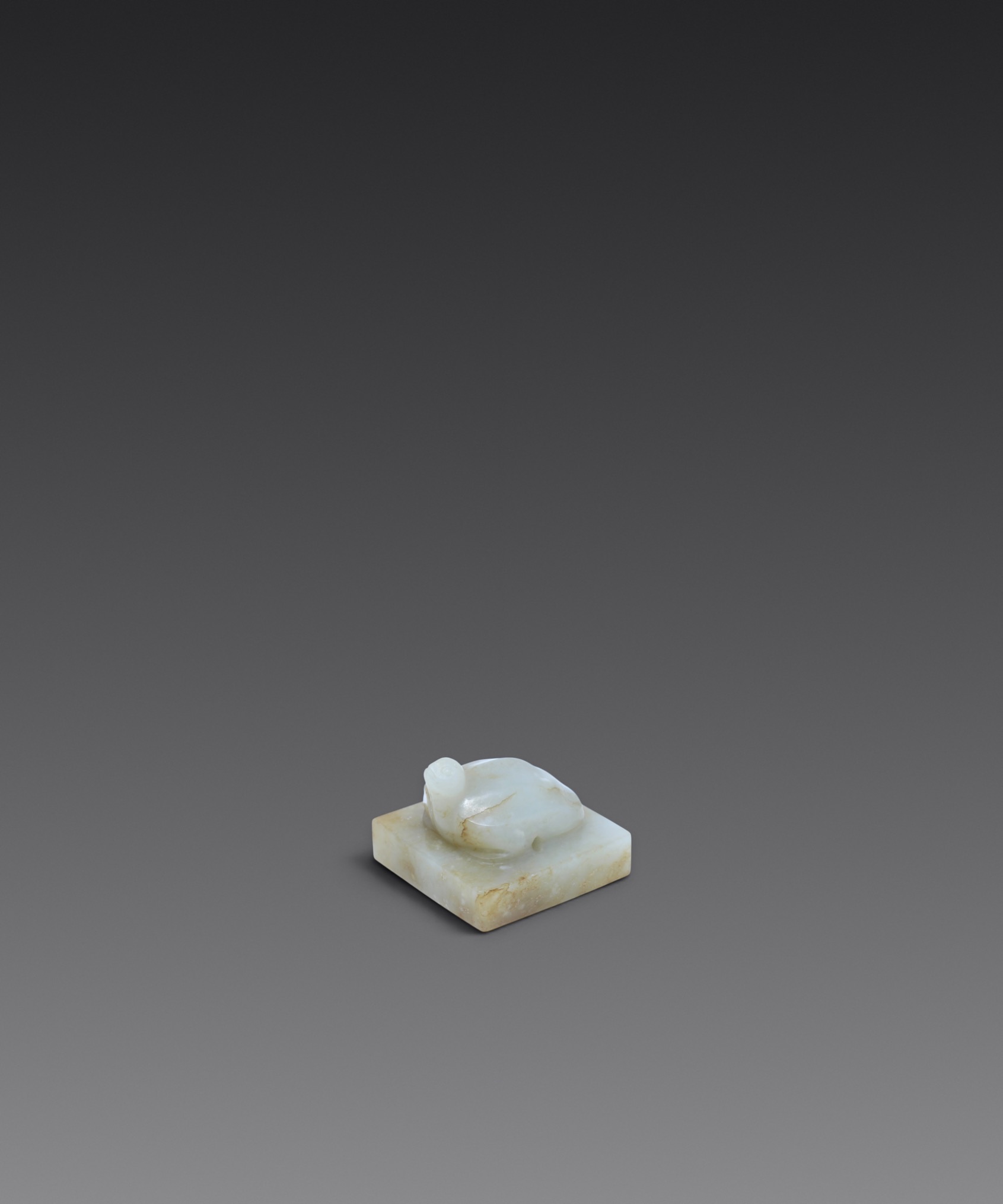
The jade seal carved from a pale celadon stone with russet inclusions and surmounted by a turtle in a seated position, its head raised, resting upon the base. The seal face carved with a four-character inscription.
A white and russet jade turtle seal (Song dynasty, 960–1279)
Description
Dimensions:
3.5 cm long, 3.5 cm wide, 2.7 cm high.
Provenance:
A private Asian collection
The jade seal carved from a pale celadon stone with russet inclusions and surmounted by a turtle in a seated position, its head raised, resting upon the base. The seal face carved with a four-character inscription.
In Chinese art, the turtle symbolises longevity, endurance and auspicious protection, qualities particularly appropriate to an object embodying its owner’s identity and authority. During the Song dynasty (960–1279), seals authenticated official and private documents, while scholars and collectors employed their impressions to mark ownership and record the provenance of paintings and calligraphy. Many Chinese seals dating from the Han dynasty and subsequent periods feature a channel pierced through the animal finial or bridge-shaped knob, allowing a silk cord or ribbon to be threaded through for suspension from a belt or carriage as a personal emblem of office.
Additional information
| Period | Song dynasty (960–1279) |
|---|---|
| Dimensions | 3.5 cm long, 3.5 cm wide, 2.7 cm high |